PuspoPurno
Education Center
Pre-primary to third grade: The most important educational stage in a child's life :
Just as the stability of a multi-storey building depends on its strong foundation, similarly, the foundation of a person's entire life's education is formed in his childhood. Especially, the period from pre-primary (play-nursery) to third grade can be called the most sensitive and important stage of a child's formal education. During this 5-6 year age, not only does the child's brain develop rapidly, but also a permanent form of his social and mental behavior is formed.
The main objective of this level is not just memorization, but to create the joy of learning.
The main goal of education for children of this age should be to awaken their curiosity and love for learning. More emphasis should be placed on the following topics at this time than on traditional rote learning:
01. Acquisition of language skills: Ability to speak, read and write mother tongue well. As well as making an initial introduction to the English language.
02. Number and Math Concepts: Explain basic math concepts like addition, subtraction, multiplication, and division in a simple way through practical materials.
03. Social Values and Discipline: Getting along with classmates, sharing, listening to the teacher, and learning general politeness and discipline.
04. Developing creativity: Drawing pictures, telling stories, making paper crafts, and learning new things through the rhythm of rhymes.
------------------------
Pre-primary (Play, Nursery & KG):
The main mantra of this level is "education through play". Children should not be pressured by any books or exams.
01. Colorful flash cards, toys, and charts should be used to recognize the alphabet and numbers.
02. Introducing pronunciation and melody through rhythm and rhyme.
03. Practice scribbling or drawing to hold a pencil and rotate the hand.
------------------------
First and Second Grade :
At this level, children begin to become accustomed to institutional rules.
01. Develop the habit of constructing short sentences, spelling, and simple reading.
02. Teaching small mathematical calculations using examples from everyday life (e.g., adding and subtracting by counting chocolates or marbles).
03. To provide a basic understanding of the environment and surrounding nature.
------------------------
Third class :
This class is a turning point in primary education. Here the scope of learning expands somewhat.
01. Children acquire the ability to read and understand large paragraphs on their own.
02. In mathematics, the practice of slightly more complex calculations such as addition, multiplication, and division begins.
03. There is formal introduction to topics such as science, society, and the environment. Therefore, it is important to explain why and how things happen rather than memorizing them.
------------------------
The role of an ideal teacher and guardian :
The joint role of teachers and parents behind the success of students at this level is undeniable.
01. Patience and empathy: Children of this age will make mistakes. You should explain them patiently without getting angry or scolding them. Excessive discipline can create fear and reluctance towards learning in the child's mind.
02. Encouragement and praise: Praise your child for even the smallest successes. A clap for a correct answer or a "well done" boosts their confidence manifold.
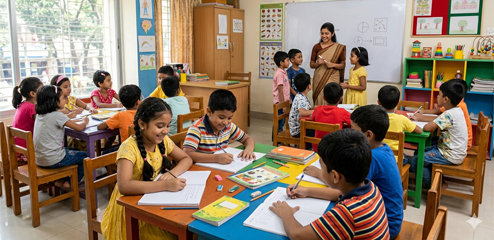
03. A pleasant learning environment: The classroom and study room should be attractive and light-filled. Colorful charts and pictures on the walls help to keep children's attention.
04. Connection with real life: Reading books should not be limited to books. They should increase their practical knowledge by going to the market, doing calculations, watering plants or observing birds.
------------------------
The period from pre-primary to third grade is not just a competition to get good marks in exams; rather, it is an opportunity to give wings to a child's curious mind. If they are educated during this time with proper care, love, and a joyful environment, then in the future they will not only become good students, but also become excellent and humane people.